
Giant Gippsland Earthworm












Website by VP-IT
All photographs © Dr. Beverley Van Praagh, Invert-Eco unless otherwise stated. No image may be saved, copied, reproduced or distributed without prior permission from the copyright owner.
Email: info@giantearthworm.org.au
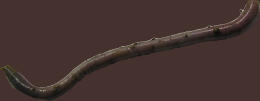

An exciting 18-month project is now underway to improve our understanding and protection of the Giant
Gippsland Earthworm (GGE) - one of the world’s largest earthworms. Led by a consortium of local
organisations, this project brings together scientific research and on-ground Landcare actions to investigate a
key but poorly understood threat to the species: changes in soil hydrology.
Soil hydrological processes play a critical role in shaping GGE habitat and influencing the species’ distribution.
However, the specific soil moisture, temperature, and oxygen conditions that support GGE colonies remain
unknown. Nor do we yet understand how much change these earthworms can tolerate before habitat
becomes unsuitable.
Alterations to natural drainage - such as through urban development, dam construction, retarding basins, or
even dense revegetation near colonies - are known to increase the risk of drying or flooding soils. Combined
with the effects of climate change, these changes could have significant implications for GGE survival. By
combining mapping of GGE sites, soil monitoring, and targeted habitat protection works, the project aims to
identify the hydrological conditions most critical to GGE and to guide future land management decisions across
the species’ range.
Project partners include:
Gippsland Threatened Species Action Group, South Gippsland Landcare Network, Bass Coast Landcare
Network, Invert-Eco Terrestrial Invertebrate Consulting, Oates Environmental Consulting, Drift Media, and Water
Technology.
With funding support from the Australian Government’s Saving Native Species Program, the project will:
•
Protect GGE colonies across four properties in South Gippsland through detailed habitat mapping, landholder agreements, and targeted on-ground
conservation works;
•
Launch a pilot soil hydrology study to monitor soil moisture, temperature, and oxygen levels over a 12–15 month period at one property;
•
Share insights through field days, educational videos and case studies through www.giantearthworm.org.au and Landcare Partner Network websites.
Project Resources:
•
GGE & Soil Moisture Fact Sheet
•
Managing Cattle, Sheep & GGE Case Study
•
GGE Interactive Resource
•
Fact sheet about planting around GGE colonies
•
Video showing how to identify GGE habitat
For more information:
cassie@sgln.net.au
joel.geoghegan@basscoastlandcare.org.au
New Project: Threat Mitigation and Soil Hydrology for the Giant Gippsland Earthworm

This project received grant funding from
the Australian Government
Saving Native Species Program.
Click to enlarge
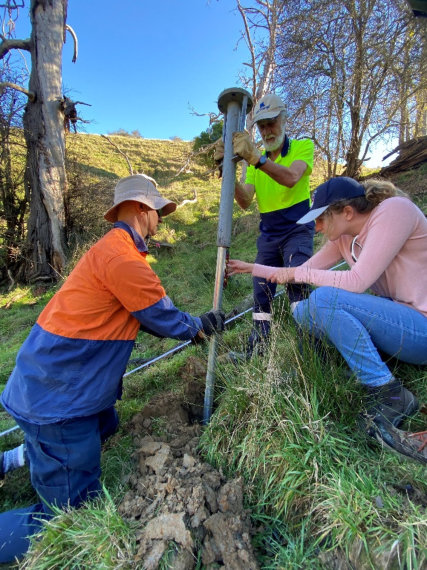
Installing soil moisture
monitoring probes at a
project site in South Gippsland
The Threat Mitigation and Soil Hydrology for the Giant Gippsland Earthworm project is a collaboration between:






Giant Gippsland Earthworm
All photographs © Dr. Beverley Van Praagh, Invert-Eco unless otherwise stated.
No image may be saved, copied, reproduced or distributed without prior
permission from the copyright owner.
Email: info@giantearthworm.org.au
Website by VP-IT
Hydrology Project
• Project Profile • Project Reports o Vegetation Report o Hydrology Report o GGE & Hydrology Report • GGE Interactive Resource


An exciting 18-month project is now underway to improve
our understanding and protection of the Giant Gippsland
Earthworm (GGE) - one of the world’s largest earthworms.
Led by a consortium of local organisations, this project brings
together scientific research and on-ground Landcare actions
to investigate a key but poorly understood threat to the
species: changes in soil hydrology.
Soil hydrological processes play a critical role in shaping GGE
habitat and influencing the species’ distribution. However,
the specific soil moisture, temperature, and oxygen
conditions that support GGE colonies remain unknown. Nor
do we yet understand how much change these earthworms
can tolerate before habitat becomes unsuitable.
Alterations to natural drainage - such as through urban
development, dam construction, retarding basins, or even
dense revegetation near colonies - are known to increase the
risk of drying or flooding soils. Combined with the effects of
climate change, these changes could have significant
implications for GGE survival. By combining mapping of GGE
sites, soil monitoring, and targeted habitat protection works,
the project aims to identify the hydrological conditions most
critical to GGE and to guide future land management
decisions across the species’ range.
Project partners include:
Gippsland Threatened Species Action Group, South
Gippsland Landcare Network, Bass Coast Landcare Network,
Invert-Eco Terrestrial Invertebrate Consulting, Oates
Environmental Consulting, Drift Media, and Water Technology.
With funding support from the Australian Government’s
Saving Native Species Program, the project will:
•
Protect GGE colonies across four properties in South
Gippsland through detailed habitat mapping, landholder
agreements, and targeted on-ground conservation works;
•
Launch a pilot soil hydrology study to monitor soil
moisture, temperature, and oxygen levels over a 12–15
month period at one property;
•
Share insights through field days, educational videos and
case studies through www.giantearthworm.org.au and
Landcare Partner Network websites.
Project Resources:
•
GGE & Soil Moisture Fact Sheet
•
Managing Cattle, Sheep & GGE Case Study
•
GGE Interactive Resource
•
Fact sheet about planting around GGE colonies
•
Video showing how to identify GGE habitat
For more information:
cassie@sgln.net.au
joel.geoghegan@basscoastlandcare.org.au
New Project: Threat Mitigation and Soil
Hydrology for the Giant Gippsland
Earthworm
This project received grant funding from
the Australian Government
Saving Native Species Program.
Click to enlarge
Installing soil moisture
monitoring probes at a
project site in South Gippsland
The Threat Mitigation and Soil Hydrology for the
Giant Gippsland Earthworm project is a
collaboration between:
